


Quick Answer
In 2026, most law firm websites cost between $0 and $300 to start on a DIY builder (plus $16 to $40 a month), $1,500 to $5,000 for a freelance build, and $5,000 to $20,000 for a full agency site. Solo and small firms typically land in the $3,000 to $8,000 range, while established firms in competitive markets invest $8,000 to $20,000 or more. Where you fall depends on a handful of decisions you actually control, not luck.
You know you need a better website. What you don't know is how much it should actually cost, and whether what you're being quoted is worth it.
That uncertainty is normal. Ask three vendors what a law firm website design costs and you'll get three wildly different answers, from $20 a month to $30,000 up front, with very little explanation of what separates them. By the end of this guide you'll know exactly what to budget, which build option fits a firm like yours, and what actually moves a website from "fine" to one that brings in clients.
Here's why this matters more than it might seem. Stanford's Web Credibility research found that people routinely judge the trustworthiness of an organization based on how its website looks and feels. For a profession built entirely on trust, that's not a design detail. It's a business problem. So let's make the money part simple.
What Does a Law Firm Website Actually Cost?
Here is the whole breakdown on one screen. These are realistic 2026 ranges, leaning toward what a budget-conscious solo or small firm should actually expect to pay rather than top-of-market agency pricing.
| Build Option | Upfront Cost | Monthly Cost | Best For |
|---|---|---|---|
| DIY builder (Wix, Squarespace) | $0 to $300 | $16 to $40 | Solo attorneys just testing the waters |
| WordPress Website | $500 to $3,000 | $20 to $100 | Small firms wanting flexibility on a sensible budget |
| Custom Web Design | $5,000 to $20,000+ | $100 to $500+ | Firms with budget who want tailored features |
| Legal Web Platforms | Often bundled | $80 to $200 | Firms tied to legal software suites |
1. DIY Website Builders (Wix, Squarespace, Webflow)
A DIY law firm website costs you around $16 to $40 a month, with little to no upfront cost. You pick a template, drag your content in, and publish.
Good at: speed, low cost, and getting a clean presence live in a weekend without hiring anyone.
Falls short: templates often look like templates, and law is a credibility game. SEO control is limited, and these sites are hard to scale as your firm grows.
Best for: a solo attorney who needs a professional presence fast and cheap, or anyone testing an idea before investing properly.
2. WordPress Website For Attorneys:
A WordPress law firm website costs you around $500 to $3,000 to set up, then roughly $20 to $100 a month for hosting and tools. You own the site and can extend it however you want.
- Good at: flexibility, full ownership, a huge ecosystem of plugins, and strong SEO potential. It hits the sweet spot between a cheap builder and a costly custom build.
- Falls short: the maintenance is yours. A neglected WordPress site with outdated plugins becomes a security liability rather than an asset, so you either learn to manage it or pay someone to.
- Best for: small and growing firms that want a professional, fully owned site with room to scale, without a bespoke price tag. For most small practices, this is the smart starting point.
3. Custom Web Design (Freelancer or Agency):
A custom law firm website design costs you around $5,000 to $20,000 or more, though a small freelance build can start near $1,500, plus $100 to $500 a month for ongoing work.
- Good at: a site shaped entirely around your firm, with tailored features, strategy, copywriting, and conversion design handled for you. A freelancer suits a moderate budget and clear preferences, while an agency packages everything together for firms that treat their website as a marketing investment.
- Falls short: cost and timeline, and quality is not guaranteed by price. A $20,000 site is not automatically better than a $5,000 one, so ask for law firm examples and conversion numbers, not just a pretty portfolio.
- Best for: firms with a healthy budget that want custom features and a design built to rank and win competitive cases. If you have the budget and want it built exactly your way, this is the move.
4. Legal-Specific Website Platforms:
A legal-specific platform costs you around $80 to $200 a month, usually bundled into a single fee. These come from companies that build software specifically for law firms.
- Good at: legal features built in, fast setup, and one vendor to call when something breaks.
- Falls short: design flexibility is limited, and you often do not own the site. If you switch providers, your website may not come with you.
- Best for: firms already using a legal software suite that bundles a web presence.
Which Option Is Right for Your Firm?
Skip the analysis paralysis. Find the description that matches you, and remember that you do not have to make the call alone. We can guide you at every stage, from picking the right option to building it.
If You Are a Solo Attorney Just Launching:
start with a DIY builder or a legal-specific platform and keep your total cost under $100 a month. Do not overbuild. Nail the basics first: a clean homepage, a bio that earns trust, and an obvious way to contact you. If you would rather skip the guesswork, we can set up and polish a builder like Wix so it looks professional from day one.
If You Are A Startup Law Firm:
WordPress is the sweet spot. Budget roughly $500 to $3,000 up front for a professional, fully owned site, and prioritize one page per practice area, real attorney profiles, and a blog you will actually keep up with. This is where our WordPress design service fits best, giving small and growing firms a site built to rank and convert without a bespoke price tag.
If You Are An Established Law Firm:
Treat the website as a marketing asset, not a brochure. Custom web design earns its fee here, with tailored features and a design built to win competitive cases. Budget in the $5,000 to $20,000 range and expect three to six months for a serious build. Our custom design team handles strategy, design, and copy as one package so nothing falls through the cracks.
If You Are Redesigning An Existing Site:
Audit before you spend. Is the problem speed, content, design, or all three? Do not pay to rebuild what only needs refining. We can run that audit for you and recommend the smartest fix, whether that is a refresh or a full rebuild.
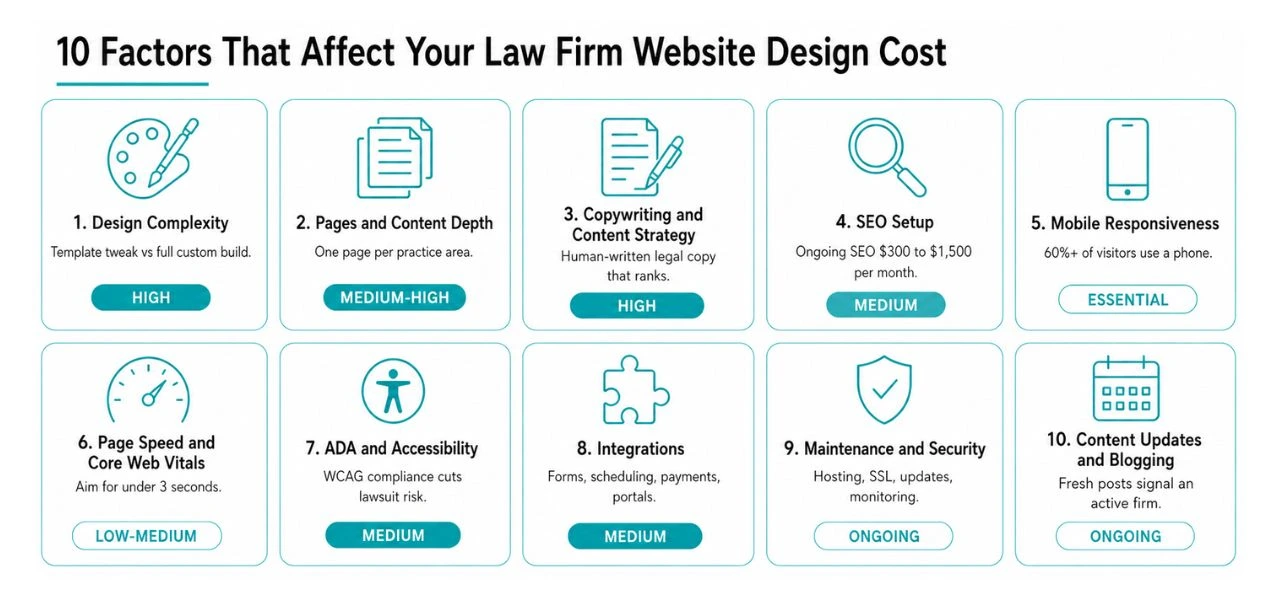
Factors Affecting The Law Firm Website Design Cost?
Price is the output of choices. Here are the factors that decide where you land, and why each one costs what it does.
1. Design Complexity:
A customized template means a designer adjusts an existing layout with your colors, fonts, and content. A from-scratch custom design means someone draws and builds the whole thing around your firm. The gap between them is mostly developer hours. Custom matters when you're fighting for distinction in a crowded market. It's wasted money when a polished template would have done the job.
2. Number Of Pages And Content Depth:
A typical law firm site needs a homepage, an about or attorney bio section, one page per practice area, a blog, and a contact page. Many also add a client portal. Practice area pages matter most here, because search engines reward a dedicated page per service far more than a single lumped "our services" list. Every page is content to write and a layout to build, so page count is a real cost lever.
3. Copywriting And Content Strategy:
This is the line item firms underestimate most. Good legal copy has to satisfy search engines and speak to a client who is often frightened and looking for help. In 2026 there's a sharper reason to take it seriously: the content that ranks well, and that AI search tools cite, is content written by a person in your firm's voice. Generic AI-generated copy with light edits tends to read flat and can quietly hurt your visibility rather than help it.
4. SEO Setup:
Separate two things. Basic technical SEO (clean code, titles, sitemaps) is usually baked into a competent build at no extra charge. Ongoing SEO strategy (keyword targeting, content, link building) is a separate monthly service, commonly $300 to $1,500 a month depending on how competitive your market is. For most firms the highest-value piece is local SEO, since clients search for a lawyer near them.
5. Mobile Responsiveness:
This is not optional. In 2026, more than 60% of legal website visitors arrive on a phone, and Google ranks sites based on mobile performance, not desktop. A site has to be built mobile-first, and building it right from the start costs less than retrofitting a desktop site later.
6. Page speed and Core Web Vitals:
A faster site usually means a higher law firm website design cost for you. Clean code, compressed images, fewer plugins, and the right hosting take skilled, detailed work, and that time costs money. Slow pages hurt rankings, so aim for under three seconds and ask whether speed optimization is included or billed as a costly extra.
7. ADA And Accessibility Compliance:
Law firms have been targeted by lawsuits over websites that screen readers and keyboard users can't navigate. Building to WCAG accessibility standards (alt text on images, keyboard navigation, sufficient color contrast) is both the right thing to do and a way to manage legal risk. For an attorney audience, that framing should land immediately.
8. Integrations
Intake forms, online scheduling, secure document portals, and payment processing each add setup cost. Some legal-specific platforms include these out of the box, which can make their flat monthly fee a better deal than it first looks.
9. Ongoing Maintenance and Security:
Budget for this from day one. Basic hosting runs roughly $50 to $200 a year, managed hosting more like $200 to $500. Add an SSL certificate, plugin and theme updates, and security monitoring. These are the costs attorneys most often forget to plan for.
What Does a High-Performing Law Firm Website Actually Need?
Cost answers "how much." This answers the more important question: what should the site actually do?
A clear value proposition on the homepage. Within about five seconds, a visitor should know who you help, where you practice, and why they should trust you.
Attorney bios that feel human. A real photo, a clear professional history, and a touch of something relatable. Credentials alone don't build connection.
Practice area pages built for SEO. One dedicated page per service, not a single combined list. This is how clients find the specific help they're searching for.
Social proof. Client testimonials (within your state bar's advertising rules), case results where permitted, and peer endorsements all reinforce credibility.
A frictionless contact experience. Phone number in the header, a simple contact form, and ideally a scheduling tool so people can book without a phone call.
Mobile-first design. Open the site on your own phone before launch. If it's awkward there, you're losing the majority of your visitors.
Fast load times. Aim for under three seconds, in line with Google's page experience guidance.
Accessibility. Alt text, keyboard navigation, strong color contrast, and screen reader compatibility, following WCAG standards.
Content that machines can read. New for 2026: AI search tools and assistants increasingly summarize options for clients before a human ever lands on your page. Clean heading structure and clear, factual practice area answers make your site easy for those tools to read and cite. Content buried inside heavy carousels and scripts is invisible to them.
How to Get the Most From Your Website Investment?
Five tactical moves that separate a website that earns its cost from one that just sits there.
1. Audit before you build:
If you're redesigning, run a Google Search Console report, a PageSpeed Insights test, and a quick mobile usability check first. Know exactly what's broken before you spend a dollar fixing it.
2. Write your content before the designer starts:
Most website projects stall because the client hasn't written the copy. Designers can't lay out pages that have no words. Hire a legal copywriter or block two solid weeks for your team to draft everything.
3. Don't over-invest in features you won't use:
A client portal sounds impressive, but if your intake process doesn't support one, it's dead weight. Buy for the firm you are now, with room to grow into the firm you're becoming.
4. Set a 90-day post-launch plan
Going live is step one. Getting traffic is step two. Before launch day, have a plan for basic local SEO, an updated Google Business Profile, and a simple content calendar.
5. Track conversions, not just traffic.
Visitor counts mean nothing if you don't know how many became clients. From day one, set up goal tracking for contact form submissions and clicks on your phone number.
Why a Great Website Is One of the Best Investments a Law Firm Can Make
By now the attorney website cost may feel steep, but the right spend pays you back. A well-built site works around the clock to win trust, attract clients, and turn searches into signed cases. Here is exactly how that investment earns its keep over time.
1. Your website works around the clock:
It answers questions, builds credibility, and captures leads while you're in a deposition or asleep. No employee delivers that for this kind of money.
2. Local SEO compounds over time:
A well-built site with consistent content and steady local SEO grows more valuable every year. Paid ads stop working the moment you stop paying. A strong organic presence keeps earning.
3. Your website pre-qualifies clients:
When your site clearly explains who you serve and how consultations work, you attract better-fit inquiries and field fewer calls that were never going to go anywhere.
Frequently Asked Questions
A DIY site can go live in a weekend. A freelance build typically takes four to eight weeks. A full agency project with strategy, custom design, and copywriting usually runs three to six months. The single biggest cause of delay is content that isn't written yet, so start that early.
Final Thoughts:
The right law firm website is not the most expensive one. It is the one that fits where your firm is today and where you want to be in three years. Once you view attorney website costs that way, the budget gets easier to plan, and most firms see the strongest return from a professional agency build.
That is where Nexal IT Services comes in. We design law firm websites built to rank, convert, and grow with your practice, with clear pricing and full ownership. Whether you want WordPress or a fully custom agency build, we will explain your attorney website costs and build a site that pays for itself.